
Small Water Chillers for Industrial Equipment Cooling
GESON small water chillers are engineered for compact process and equipment-cooling loops where load, temperature stability, pump duty, footprint and electrical supply must be evaluated together. “Small” is not a standardized capacity class: the correct unit is the one that delivers the required net cooling at the specified fluid temperature and ambient condition.
Typical project categories include laser and optical equipment, machine tools, laboratory instruments, analytical equipment, small production lines and pilot processes. Application suitability must be confirmed from the equipment heat load, allowable fluid, flow, pressure and connection requirements.
What Is a Small Recirculating Water Chiller?
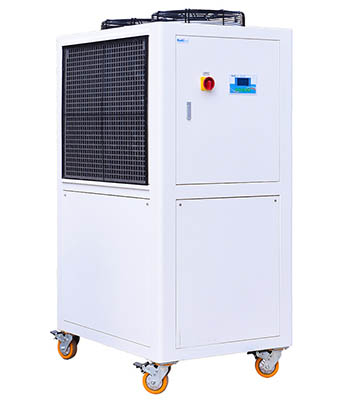
A recirculating chiller removes heat from a closed fluid loop and returns temperature-controlled liquid to the application. A packaged unit may combine a refrigeration circuit, fluid heat exchanger, circulation pump, reservoir, controller and protection devices. Exact scope varies by project and must be listed in the quotation.
The refrigerant circuit and process-fluid circuit remain separate across the evaporator. The process fluid carries heat from the equipment to the chiller; the refrigerant transfers that heat to an air-cooled or water-cooled condenser.
- Cooling circuit: compressor, condenser, expansion device, evaporator and controls.
- Fluid circuit: pump, reservoir if required, piping, strainer, connections and flow protection.
- Application interface: allowable fluid, supply/return temperatures, flow, pressure, wetted materials and connection sizes.
Seven Inputs That Define a Small Chiller Unit
Thermo Fisher’s recirculating-chiller selection note starts with heat load, setpoint temperature, flow rate and application pressure loss, then adds site and control requirements. The same engineering logic applies to an industrial small chiller.
| Selection input | What to provide | Why it changes the unit |
|---|---|---|
| Net heat load | Measured or calculated sustained and peak load in W or kW. | Defines required cooling capacity at the design point. |
| Fluid temperature | Entering and leaving temperatures or setpoint and allowable return temperature. | Changes evaporating condition and available capacity. |
| Flow | Required operating flow and allowed range. | Sets heat transfer and pump operating point. |
| Pressure loss | Application, hoses, fittings and chiller-side pressure drop at design flow. | Determines required pump head without exceeding device pressure limits. |
| Fluid | Water, inhibited glycol or approved process fluid; concentration and temperature. | Changes heat capacity, viscosity, materials and freeze protection. |
| Site condition | Maximum/minimum ambient, altitude, dust, humidity and installation location. | Affects condenser capacity, airflow, enclosure and operating envelope. |
| Power and control | Voltage, phase, frequency, alarm contacts and communication needs. | Defines electrical configuration and integration scope. |
Cooling Capacity Must Be Rated at the Required Temperature
A small chiller may have different available capacity at different fluid and ambient temperatures. Compare units only when the quotation states the same conditions:
- Net cooling capacity at the required leaving-fluid temperature.
- Entering-fluid temperature and design flow.
- Fluid type and glycol concentration.
- Outdoor or room ambient used for the rating.
- Total unit input power and electrical frequency.
- Whether pump heat is included in net capacity.
For a known loop, calculate the fluid load from mass flow × specific heat × temperature difference. The chiller sizing guide provides SI and U.S. formulas plus a worked example. Equipment power, batch pull-down and transient peaks must be added when they occur simultaneously.
Pump Flow, Head and Pressure Limits
Maximum pump flow and maximum head are not normally available at the same point. The application needs a pump curve showing the delivered flow at the total system pressure loss. Add the pressure drops of the cooled equipment, chiller heat exchanger, hoses, fittings, filters and elevation effects where applicable.
A useful hydraulic review checks:
- Required minimum and maximum equipment flow.
- Total pressure drop at design flow.
- Maximum allowable pressure of the instrument or process heat exchanger.
- Whether a bypass, pressure regulator or positive-displacement relief path is needed.
- Reservoir volume, air removal and expansion allowance.
- Hose diameter, length, insulation and material compatibility.
Oversized pumps can create noise, erosion, excessive pressure or unnecessary heat. Undersized pumps reduce flow and can cause poor process cooling or evaporator protection trips.
Temperature Stability vs Control Accuracy
These terms are often mixed in quotations:
| Term | Engineering meaning |
|---|---|
| Setpoint resolution | The smallest increment that can be entered on the controller. |
| Control stability | How much the controlled measurement varies over time under stated steady conditions. |
| Sensor accuracy | How close the sensor reading is to a traceable reference over its specified range. |
| Process temperature uniformity | Variation across the cooled equipment or process, influenced by flow and heat-exchanger design. |
| Pull-down time | Time required to cool the fluid, equipment and product from starting to target temperature. |
A display that shows 0.1°C increments does not prove ±0.1°C process stability. Define where temperature is measured, the test load, ambient, flow and evaluation period.
Air-Cooled vs Water-Cooled Small Chillers
| Factor | Air-cooled condenser | Water-cooled condenser |
|---|---|---|
| Heat destination | Rejects process heat plus chiller input into the installation air or outdoors. | Transfers heat to an external water circuit. |
| Installation need | Requires adequate ventilation and clean airflow around the condenser. | Requires suitable condenser-water temperature, flow, quality and connection. |
| Room impact | Indoor installation adds heat to the room HVAC load. | Can move heat out through the facility water loop, subject to its capacity. |
| Maintenance focus | Coil and fan inspection/cleaning. | Water-side fouling, treatment and heat-exchanger inspection. |
Thermo Fisher notes that an indoor air-cooled recirculating chiller rejects both application heat and chiller electrical input to the room. Include that heat when checking ventilation or air-conditioning capacity.
Small Chiller Applications and Interface Questions
The application name does not replace the equipment manual. Before connecting a laser, spindle, analytical instrument or pilot process, confirm:
- Maximum heat rejection under normal and peak operation.
- Required supply temperature and allowable rate of temperature change.
- Minimum/maximum flow and pressure.
- Approved fluid chemistry and wetted materials.
- Connection size, hose length and filtration requirement.
- Whether separate temperature circuits are required.
- Alarm, interlock and shutdown behavior during loss of flow or high temperature.
GESON does not claim universal compatibility with every laser or instrument. Provide the equipment cooling specification so our engineer can compare it with the proposed chiller operating point.
Packaged Scope and Installation Checklist
A quotation should identify whether the pump, tank, bypass, filter, heater, casters, hoses and communication hardware are included. For a broader packaged system, review the industrial chiller system scope.
- Confirm level support, ventilation clearance and service access.
- Verify voltage, phase, frequency, circuit protection and grounding.
- Flush the external loop before connecting it to the chiller.
- Use the approved fluid and concentration; remove trapped air.
- Check flow and pressure before enabling the cooled equipment.
- Insulate cold lines where condensation can occur.
- Record baseline supply/return temperatures, flow, ambient and alarm status.
Refrigerant and Service Planning
GESON can evaluate new small-chiller configurations using R454B or R513A where the selected compressor, unit design, fluid temperature, destination regulations and qualified service capability permit. The offered refrigerant and required safety provisions will be confirmed for the specific model in the written proposal.
For legacy GESON R22 equipment, model-dependent spare-parts and refrigerant-related service can be assessed. Provide the nameplate, serial number, photos, fault description and destination; support depends on parts availability, local rules and qualified service scope.
Small Water Chiller FAQ
How do I choose a small water chiller?
Start with net heat load, required supply/return temperatures, flow, total pressure loss, fluid, maximum ambient, power supply and equipment interface limits. Select from capacity and pump curves at those conditions rather than from physical size or nominal watts alone.
Is a small recirculating chiller the same as an aquarium chiller?
No. Industrial recirculating chillers are selected for equipment heat load, fluid cleanliness, pump pressure, control, materials and interlocks. Aquarium products serve different safety, biological and installation requirements. This page covers industrial and laboratory equipment cooling.
Does a small chiller include a pump and tank?
It can, but packaged scope varies. The quotation must state the pump curve, reservoir volume, bypass/protection, connections and included accessories. Do not assume every unit contains the same hydraulic components.
How is small chiller cooling capacity stated?
Capacity should be stated in W or kW at specified leaving/entering fluid temperatures, flow, fluid composition and ambient. Electrical power is not the same as cooling capacity, and capacity at one temperature cannot be applied unchanged at another.
Can a small chiller use glycol?
Yes, when selected for the specified glycol type, concentration and temperature. Glycol changes heat capacity, viscosity, pressure drop and material requirements, so both the cooling and pump selections must use the correct fluid data.
How much does a small water chiller cost?
Price depends on rated capacity and temperature, pump duty, tank and hydraulic scope, condenser type, controls, refrigerant, voltage, materials and destination. Provide the application data for a model-specific technical and commercial quotation.
Request a Small Chiller Quote
Send the application, equipment heat load, entering/leaving fluid temperatures, flow, pressure loss, fluid or glycol concentration, ambient, voltage and destination country. Attach the cooled-equipment manual or interface requirements when available.