INDUSTRIAL SCROLL CHILLER SYSTEMS

Industrial Scroll Chiller Systems

A scroll chiller uses one or more scroll compressors to remove heat from a circulating water or process-fluid loop. Air-cooled configurations reject heat to outdoor air; water-cooled configurations reject heat through a condenser-water circuit and external heat-rejection equipment.

GESON selects scroll chiller systems from the required cooling duty, entering and leaving fluid temperatures, flow, glycol concentration, ambient or condenser-water conditions, load profile, power supply and destination country. Capacity, input power and COP are stated only at the agreed rating conditions.

Request Chiller Selection

Air scroll chiller

When a Scroll Chiller Is a Practical Choice

Scroll chillers are commonly considered for small and medium cooling duties, modular plants and applications that benefit from multiple compressor stages. The final choice depends on available models and the project operating point—not a universal tonnage cutoff.

  • Plastic-processing and machinery cooling
  • Food, beverage and fermentation process loops
  • Laser, laboratory and equipment cooling
  • Commercial chilled-water systems
  • Modular or staged cooling plants

The process must remain within the selected compressor application envelope. Low-temperature duty, high ambient conditions, unstable flow or rapid load changes require a model-specific review.

How a Scroll Chiller Works

The evaporator transfers heat from water or process fluid into the refrigerant. Inside a scroll compressor, one scroll remains fixed while the other orbits; refrigerant pockets move inward and reduce in volume, raising refrigerant pressure. The condenser then rejects heat to air or condenser water before the expansion device lowers refrigerant pressure for the next cycle.

A single fixed-speed scroll compressor normally operates on or off. A multi-compressor package can stage compressors to follow load. Depending on the selected compressor, capacity control may also use digital unloading, two-stage operation or variable speed. These methods are not interchangeable, so the technical schedule must name the actual compressor arrangement and minimum stable capacity.

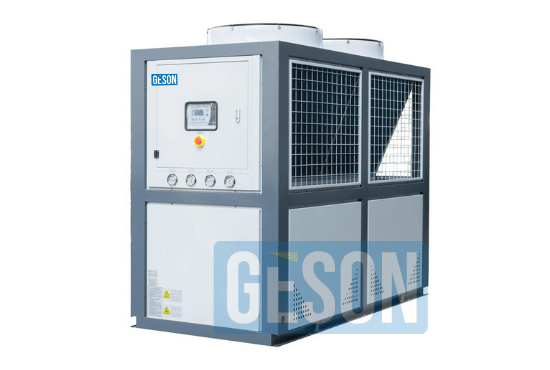
GESON air-cooled scroll chiller
Air-cooled scroll chiller configuration
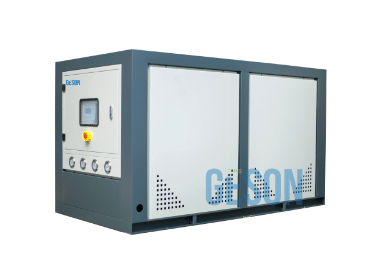
GESON water-cooled scroll chiller
Water-cooled scroll chiller configuration

Air-Cooled vs Water-Cooled Scroll Chillers

Selection factor Air-cooled scroll chiller Water-cooled scroll chiller
Heat rejection Condenser coils and fans reject heat to outdoor air A water-cooled condenser transfers heat to a condenser-water loop
External equipment No cooling tower or condenser-water pump; project still needs the chilled-fluid circuit Normally requires condenser-water pumps, a cooling tower or another approved heat sink, piping and water treatment
Primary design weather Outdoor dry-bulb temperature and airflow clearance Outdoor wet-bulb, tower approach and condenser entering-water temperature
Maintenance focus Coils, fans, airflow, corrosion exposure and drainage Condenser tubes, water quality, tower, pumps, strainers and fouling
Energy comparison Compare complete-system input at the same cooling load and water temperatures; include fans, pumps and tower auxiliaries
Technical correction: a water-cooled scroll chiller does not reject condenser heat by itself. It requires a designed condenser-water and heat-rejection path. A cooling tower is common, although another approved heat sink may be engineered.

Scroll Chiller vs Screw Chiller

Factor Scroll chiller Screw chiller
Compression mechanism Orbiting and fixed scroll elements compress refrigerant pockets Rotating screw rotors compress refrigerant
Capacity arrangement Often uses multiple compressors or circuits; digital, staged or variable-speed options depend on model May use compressor staging, slide-valve/control-piston unloading or speed control depending on model
Minimum load Depends on the number of circuits, compressor staging and modulation method Depends on compressor unloading, lift, oil management and control strategy
Service strategy Individual compressors may be replaceable modules within the refrigerant circuit Requires technicians and service planning appropriate to the screw compressor and oil system
Selection rule Compare available selections at the project rating conditions, load profile, redundancy target, maintenance capability and lifecycle cost

Rated Cooling Capacity, Power and COP

AHRI 550/590 and 551/591 define rating methods for vapor-compression water-chilling packages. A cooling-capacity or efficiency value is incomplete unless the operating condition is identified. Request a selection sheet showing:

  • chilled-fluid entering and leaving temperatures;
  • fluid type, glycol concentration and flow;
  • outdoor ambient for an air-cooled unit or condenser-water temperatures and flow for a water-cooled unit;
  • evaporator and condenser pressure drop where applicable;
  • net cooling capacity and total package input power;
  • full-load COP, EER or kW/ton at the stated condition; and
  • part-load performance using the stated standard or project conditions.

COP equals cooling capacity divided by power input at the same condition. A higher cooling COP indicates less package input per unit of cooling at that point. It does not prove lower whole-plant energy unless pumps, condenser fans, cooling-tower fans and operating hours are also considered.

Compressor Staging and Temperature Control

Multiple fixed-speed scroll compressors can be staged to match load in steps. A digital scroll compressor uses loaded and unloaded periods, while a variable-speed scroll changes motor speed within its approved operating range. Copeland and Danfoss application guidance shows that compressor arrangement, oil management, piping and controls are model-specific.

The control sequence should define leaving-fluid temperature control, compressor rotation, minimum run and off times, flow proof, freeze protection, high- and low-pressure protection, current limit, alarm history and remote enable. BMS communication options must be confirmed for the selected controller rather than promised across every model.

Low-Temperature and Glycol Applications

Sub-zero process-fluid temperatures reduce evaporating temperature and may move a compressor outside its normal application envelope. They also increase freeze risk and change cooling capacity, input power, evaporator design and fluid pressure drop.

Provide the exact glycol or secondary fluid and concentration. The selection must account for density, specific heat, viscosity, freezing point, flow and pump power. Do not infer low-temperature capability from the word “scroll” or from a generic product-family temperature range.

Refrigerant Selection and Legacy Support

  • New R454B chillers: available from GESON subject to the selected scroll-chiller model, rated conditions, safety design, destination regulations and written confirmation.
  • New R513A chillers: available from GESON subject to model, operating conditions, destination requirements and written confirmation.
  • Legacy GESON R22 equipment: spare-parts and refrigerant-related service support is available subject to the original model, equipment condition, local refrigerant rules, qualified-technician scope and written confirmation.

The exact refrigerant and safety classification must appear in the technical proposal. The phrase “environmentally friendly refrigerant” is not a substitute for checking local restrictions, charge limits, machinery-room requirements and long-term service availability.

Installation, Hydraulics and Maintenance Access

The chilled-fluid circuit should include the flow protection, filtration, expansion, venting, drainage, insulation and minimum system volume required by the selected unit. Short water loops may need added buffer volume to prevent rapid cycling and unstable leaving temperature.

For air-cooled units, confirm condenser airflow clearance, hot-air recirculation risk, sound limits, wind and corrosion exposure. For water-cooled units, confirm tower selection, condenser-water flow, treatment program and tube-cleaning access. Both configurations require lifting, foundation, service-clearance and electrical reviews.

Information Required for Scroll Chiller Selection

Required input Why it matters
Application and calculated heat load Defines the design duty and load pattern
Required cooling capacity Must be checked at the actual operating point
Fluid entering and leaving temperatures Sets the evaporator and compressor condition
Fluid flow Determines heat-exchanger duty and pressure drop
Fluid or glycol type and concentration Affects freezing point, heat transfer, viscosity and pump selection
Maximum ambient temperature Defines the air-cooled condensing condition
Condenser-water temperatures and flow Defines water-cooled heat rejection and condenser pressure drop
Minimum, typical and peak load Supports compressor quantity, staging and modulation decisions
Operating hours and redundancy Influences equipment quantity and maintenance strategy
Voltage, frequency and phase Defines electrical configuration
Installation limits and sound requirement Supports layout, airflow and acoustic review
Destination country and required documents Supports refrigerant, electrical and code review

Scroll Chiller FAQ

What is a scroll chiller?

A scroll chiller is a vapor-compression liquid chiller using one or more scroll compressors. It can reject heat through an air-cooled condenser or a water-cooled condenser connected to an external heat-rejection system.

Is an air-cooled or water-cooled scroll chiller better?

Neither is always better. Air-cooled units avoid a cooling tower and condenser-water circuit. Water-cooled units add tower, pumping and water-treatment requirements. Compare complete systems at the same load and rating conditions.

Does a water-cooled scroll chiller need a cooling tower?

A cooling tower is common but not mandatory in every engineered plant. The chiller needs an approved condenser-water heat sink, which may be a tower, dry cooler, closed-circuit cooler, heat-recovery load or another suitable system.

What is the difference between a scroll and screw chiller?

They use different positive-displacement compressor mechanisms and capacity-control arrangements. The better choice depends on available models, rating conditions, load profile, minimum load, redundancy, service capability and lifecycle cost.

Can GESON provide R454B or R513A scroll chillers?

GESON can provide new chillers using R454B and R513A. Availability for a specific scroll-chiller model requires confirmation of capacity, operating conditions, safety design, destination requirements and the written proposal.

What should I send for a scroll chiller quotation?

Send the application, design load, entering and leaving fluid temperatures, flow, fluid or glycol concentration, ambient or condenser-water conditions, operating profile, power supply, installation limits and destination country.

Request a Scroll Chiller Selection

Send GESON the application, load, fluid temperatures, flow, heat-rejection conditions, power supply and destination. The proposal will identify the selected configuration, rated capacity and power, refrigerant, controls, water-side data and supply scope.

Contact Our Engineer

Engineering References

Related resources: air-cooled chillers, water-cooled chillers, water-cooled screw chillers, air-cooled vs water-cooled chillers, and the maintenance checklist.