
Standby
Unit availability and system interlocks are reviewed before operation.
GESON / SCREW COMPRESSOR CHILLER SYSTEMS
CONTINUOUS DUTY · STEPWISE LOAD CONTROL · ENGINEERED SYSTEM SCOPE
Choose the heat-rejection route, then define the duty. GESON screw chillers are reviewed around the operating hours, part-load behavior, fluid temperatures and project boundary—not a capacity number in isolation.
SCREW CHILLER / DEFINITION
A screw chiller is an industrial or commercial cooling system built around a screw-type compressor. The selected package combines the compressor arrangement, evaporator, condenser route, expansion control and project interfaces for a defined chilled-fluid duty.
Start with the load curve and operating conditions. The proposal then confirms capacity, input power, controls and component configuration for the selected model.
PART-LOAD REVIEW
The original screw-chiller material includes a 0–25–50–75–100% capacity-control sequence for an air-cooled example. Here, it becomes a practical engineering conversation rather than a universal promise.
Unit availability and system interlocks are reviewed before operation.
Part-load conditions are assessed against the process or building profile.
The proposed configuration is evaluated at the declared operating point.
Plant utilities and heat rejection must support sustained duty.
Capacity and input power are confirmed for the agreed design conditions.
Illustrative source sequence only. Actual capacity-control steps, efficiency, sound, operating limits and power consumption are verified against the approved model and stated conditions.
CONFIGURE THE HEAT-REJECTION SIDE
The same screw-compressor concept can sit inside two very different project systems. Select the route that matches available utilities, maintenance capability, installation conditions and project responsibility.
WATER-SIDE ROUTE
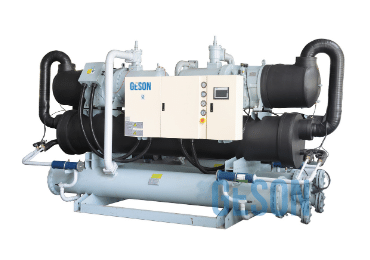
Use an engineered condenser-water loop when the project can define heat rejection, water treatment, pumps, cooling tower interfaces and maintenance responsibility as one system.
AIR-SIDE ROUTE
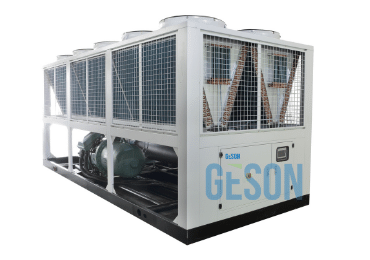
Use self-contained outdoor heat rejection when the project needs to avoid a cooling tower and condenser-water loop, while still defining ambient, airflow clearance, noise and electrical conditions.
SCREW CHILLER / SYSTEM MAP
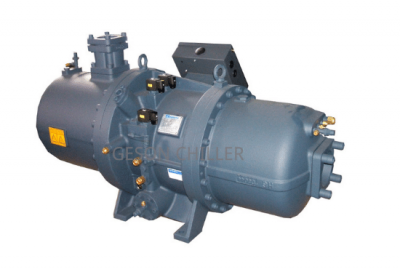
SYSTEM ARCHITECTURE
Every item below influences what is quoted, manufactured, installed and operated. Review the system boundary before comparing equipment offers.
The compressor arrangement is selected around the agreed load profile, refrigerant, capacity-control strategy and service expectations.
Define chilled-fluid type, supply and return temperatures, design flow, pressure drop, tank and pump boundary before model selection.
The condenser route changes the project scope: air-side clearance and ambient conditions, or water-side tower, pumps and water quality.
The selected control package, alarms, interlocks, remote interface and protection requirements are confirmed in the project proposal.
ENGINEERING INPUT BOARD
Share these items before asking for a model. They allow the quotation to identify its operating basis and divide factory supply from site responsibility.
WHERE THE DISCUSSION CHANGES
A screw chiller is commonly considered where the operating schedule, sustained demand and system stability require a defined central cooling duty.
For a central chilled-water system, the proposal should allocate pumps, buffer volume, heat rejection, controls and site piping instead of treating the chiller as an isolated unit.
The selection should consider design duty and anticipated part-load operation. Capacity steps shown on this page are an illustrative source sequence; the selected model confirms actual control behavior.
SCREW CHILLER FAQ
A screw chiller is a chilled-water or process-cooling system using a screw-type compressor. It is typically evaluated for industrial and commercial applications where the required duty, operating profile and system interfaces warrant an engineered chiller package.
Choose the heat-rejection route from the site conditions. Air-cooled equipment needs design ambient, airflow clearance, sound and electrical review. Water-cooled equipment needs an engineered condenser-water circuit, including tower or heat sink, water quality, pumps and maintenance scope.
No. It reflects a capacity-control sequence shown in the source material for an air-cooled screw-chiller example. Actual unloading steps, capacity, input power and controls must be confirmed for the selected model and stated operating conditions.
Provide the application, calculated heat load, chilled-fluid supply and return temperatures, flow, fluid type or glycol concentration, heat-rejection basis, electrical supply, operating profile, installation location, site scope and destination requirements.
A project proposal can define the selected chiller together with approved accessories. The responsibilities for pumps, tanks, cooling tower, piping, controls, electrical connection and commissioning should be explicitly allocated between factory and site.
PROJECT-SPECIFIC SCREW CHILLER REVIEW
Share the application, calculated load, chilled-fluid temperatures, heat-rejection route, expected part-load operation, electrical supply and installation scope. GESON will help define a suitable screw chiller package.