
Industrial Chiller Systems for Process and HVAC Cooling
GESON engineers industrial chiller systems around the actual heat load, fluid temperatures, flow, ambient conditions and site utilities—not a nominal capacity alone. We support overseas manufacturers, engineering contractors, distributors and facility teams with air-cooled, water-cooled, scroll, screw and low-temperature configurations.
A useful proposal starts with the operating point. Tell us the application, required cooling capacity or process heat load, entering and leaving fluid temperatures, design flow, maximum ambient temperature, fluid or glycol concentration, power supply and destination country. Our engineers can then evaluate the chiller, pumping, buffer volume, controls and heat-rejection scope as one system.
What Is Included in an Industrial Chiller System?
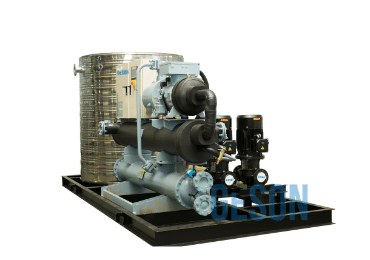
A chiller removes heat from a circulating liquid and rejects that heat to outdoor air or a condenser-water loop. The complete cooling system may include more than the refrigeration unit:
- Chiller package: compressor, evaporator, condenser, expansion device, controls and safety protection.
- Process-fluid loop: pump, buffer tank, piping, valves, strainer, insulation and expansion provision.
- Heat rejection: air-cooled condenser fans or a water-cooled condenser circuit with pump and cooling tower.
- System control: temperature control, flow proof, alarms, staging and optional communication points.
- Site integration: electrical supply, ventilation, drainage, water treatment, access and freeze protection.
The final scope depends on whether you require a packaged unit, a skid-mounted cooling module or equipment for integration into a larger plant.
Choose the Chiller System by Project Conditions
| Configuration | Best fit | Engineering checks |
|---|---|---|
| Air-cooled chiller system | Sites that prefer no cooling tower and simpler external water infrastructure. | Maximum outdoor dry-bulb temperature, airflow clearance, sound limits and winter operation. |
| Water-cooled chiller system | Plants with condenser-water infrastructure or projects prioritizing heat-rejection efficiency. | Cooling-tower approach, condenser-water temperatures and flow, water quality and pump power. |
| Scroll chiller system | Small-to-medium loads, modular staging and applications requiring simple service access. | Load profile, number of circuits, required turndown and redundancy. |
| Screw chiller system | Medium-to-large continuous or variable industrial and commercial loads. | Full- and part-load duty, compressor staging, condenser conditions and plant sequencing. |
| Low-temperature chiller system | Processes requiring leaving-fluid temperatures below normal chilled-water ranges. | Required temperature, glycol type and concentration, viscosity, pressure drop, insulation and defrost/frost protection. |
Air-cooled and water-cooled systems should not be compared using nominal capacity alone. Heat-rejection conditions, pump and fan energy, water availability, maintenance capability and annual load profile all affect lifecycle performance.
Required Data for Accurate Chiller Selection
| Input | Why it matters |
|---|---|
| Application and process | Identifies contamination risks, duty cycle, control stability and process-specific constraints. |
| Heat load or required cooling capacity | Defines the design duty. State whether the value is calculated, measured or estimated. |
| Entering and leaving fluid temperatures | Capacity and compressor lift change with the specified temperature conditions. |
| Design fluid flow | Allows the evaporator temperature difference and pressure drop to be checked. |
| Fluid and glycol concentration | Glycol changes heat capacity, viscosity, flow requirement and heat-exchanger performance. |
| Maximum ambient or condenser-water conditions | Defines the heat-rejection design point and operating envelope. |
| Load profile and operating hours | Determines whether staging and part-load performance are important. |
| Power supply and destination country | Supports electrical design and a review of refrigerant and project requirements. |
If the heat load is unknown, provide process throughput, material properties, start and target temperatures, cooling time, equipment heat input and operating schedule. We can help structure the load calculation, but the final selection must be confirmed against the agreed design data.
Capacity, COP and Efficiency Must State Rating Conditions
Published cooling capacity and efficiency are meaningful only when the rating conditions are stated. A quotation should identify the leaving and entering fluid temperatures, fluid composition, evaporator flow, outdoor ambient or condenser-water temperatures, fouling assumptions and electrical frequency. For a water-cooled plant, pump and cooling-tower power should also be considered when comparing total system energy.
Full-load COP alone does not describe a plant that operates at variable demand. Ask for full-load data and a suitable part-load metric or project load analysis. AHRI 550/590 and 551/591 provide standardized performance-rating methods for vapor-compression water-chilling packages; compliance or certification must be confirmed for the specific offered model and is not implied by this general page.
System Architecture and Control Decisions
- Single or multiple chillers: compare first cost with redundancy, maintenance continuity and low-load operation.
- Constant or variable flow: confirm each evaporator’s allowable flow range and minimum-flow protection.
- Buffer volume: short process cycles may require additional thermal volume to prevent rapid compressor cycling.
- Temperature control: define sensor location, allowable deviation, pull-down time and process response.
- Staging: sequence chillers and pumps against measured load instead of operating unnecessary equipment.
- Monitoring: useful points include supply/return temperature, flow status, pressures, current, alarms and run hours.
Refrigerant and Replacement-System Planning
GESON can offer new chiller projects using R454B or R513A where the selected equipment design, operating conditions, destination regulations and service capability permit. Availability is confirmed in the written technical proposal for the specific model. Refrigerant choice must be evaluated together with safety classification, charge, machinery-room requirements, local codes and access to qualified technicians.
For legacy GESON R22 equipment, we can provide model-dependent spare-parts and refrigerant-related technical service. This does not mean unrestricted supply of R22 in every country. Provide the nameplate, serial number, photos, fault description and site location so our team can check parts compatibility, legal constraints and whether repair, retrofit or replacement is the practical route.
From Inquiry to Technical Proposal
- Application review: we clarify the cooling load, temperatures, fluid, site conditions and operating profile.
- Configuration selection: engineers compare air- or water-cooled heat rejection, compressor type, circuits, pumps, tank and controls.
- Rated proposal: the offer states the agreed design point, equipment scope, electrical data and exclusions.
- Interface confirmation: drawings and connection requirements are reviewed before manufacturing.
- Commissioning preparation: the project team confirms piping cleanliness, water treatment, flow, power, ventilation and control interfaces.
Contact our engineer with your selection data to receive a model-specific solution and quotation.
Industrial Chiller System FAQ
What information is needed to size an industrial chiller system?
Provide the application, heat load or capacity, entering and leaving fluid temperatures, flow, fluid or glycol concentration, maximum ambient temperature or condenser-water conditions, operating hours, power supply and destination country. Nominal tonnage without these conditions is not enough for a reliable selection.
Should I choose an air-cooled or water-cooled chiller?
Air-cooled equipment avoids a cooling tower and condenser-water loop, while water-cooled equipment can suit plants with suitable water infrastructure and heat-rejection requirements. Compare site climate, water availability and quality, maintenance resources, sound, footprint and total system energy.
Can GESON supply a complete packaged chiller system?
Yes, GESON can evaluate packaged or skid-mounted scope including the chiller, pump, tank and controls. Exact boundaries, piping, heat rejection, redundancy and instruments are defined in the written proposal.
How should chiller COP be compared?
Compare COP only at the same entering and leaving fluid temperatures, flow, fluid composition and ambient or condenser-water conditions. Also review part-load behavior and auxiliary pump, fan and cooling-tower power where applicable.
Can GESON provide new chillers using R454B or R513A?
Yes, subject to the selected model, design conditions, destination regulations and local service capability. The refrigerant and safety provisions will be confirmed in the project-specific technical proposal.
Can GESON support an older R22 chiller?
Yes, GESON can assess model-dependent spare-parts and refrigerant-related service for legacy GESON equipment. Support depends on identification, parts availability, destination rules and qualified service scope; repair, retrofit and replacement options should be compared.
Request a Chiller System Proposal
Send your application, cooling load, entering and leaving temperatures, flow, fluid or glycol concentration, maximum ambient, power supply and destination country. Our engineering team will review the design point and respond with the appropriate system configuration.