
How Does a Chiller Work? Complete Guide to Chiller Systems
A chiller is a refrigeration system that removes heat from a process fluid — typically water or a water-glycol mixture — and rejects it to the environment. Chillers are used in industrial process cooling, commercial HVAC, food processing, pharmaceutical manufacturing, and data centres. This guide explains how chillers work, the main types, and how to select the right system for your application.
Get a free quotation from Geson Chiller →
How Does a Chiller Work? The Basic Refrigeration Cycle
All chillers operate on the vapour compression refrigeration cycle. There are four key stages:
- Evaporation — Low-pressure liquid refrigerant enters the evaporator. It absorbs heat from the process water, causing the refrigerant to evaporate into a low-pressure gas. The process water is cooled in this stage.
- Compression — The low-pressure refrigerant gas enters the compressor, which raises its pressure and temperature, converting it into a high-pressure, high-temperature gas.
- Condensation — The hot high-pressure gas enters the condenser, where heat is rejected to either outdoor air (air cooled) or cooling water (water cooled). The refrigerant condenses back into a high-pressure liquid.
- Expansion — The high-pressure liquid passes through the expansion valve, which drops the pressure rapidly. This causes partial evaporation and cooling, returning the refrigerant to the low-pressure liquid state — ready to enter the evaporator again.
This cycle repeats continuously, transferring heat from the process water to the environment and maintaining the chilled water at the setpoint temperature.
Chiller System Components
| Component | Function |
|---|---|
| Evaporator | Heat exchanger where refrigerant absorbs heat from the process water. Shell-and-tube design standard for industrial chillers. |
| Compressor | Raises refrigerant pressure and temperature. Types: scroll, screw, centrifugal. The compressor is the core of the chiller. |
| Condenser | Rejects heat from the refrigerant. Air cooled: copper-aluminium fin coils + fans. Water cooled: shell-and-tube heat exchanger connected to cooling tower. |
| Expansion valve | Reduces refrigerant pressure before the evaporator. Electronic expansion valves (EEV) provide precise control. |
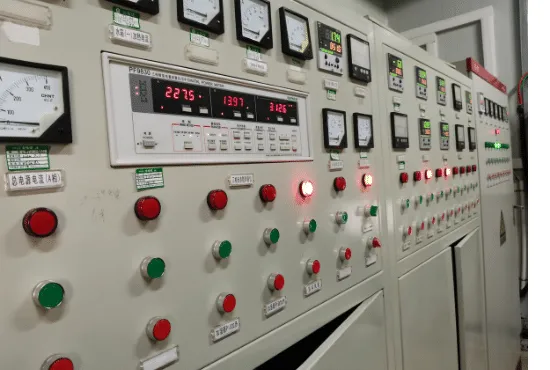
| Control system | PLC + LCD touchscreen monitors temperatures, pressures, and alarms. Remote monitoring via RS-485 or Ethernet. |
Air Cooled vs Water Cooled Chillers
| Factor | Air Cooled Chiller | Water Cooled Chiller |
|---|---|---|
| Heat rejection | Outdoor air via condenser fans | Cooling tower via condenser water circuit |
| Cooling tower required | No | Yes |
| Typical COP | 2.5 – 3.5 | 4.0 – 6.0 |
| Capacity range | 3RT – 300RT | 30RT – 4,500RT |
| Installation | Simple — outdoor mounting | More complex — indoor + cooling tower |
| Water consumption | Zero | Cooling tower evaporation loss |
| Best for | Smaller projects, no water supply | Large buildings, high efficiency required |
Types of Chiller Compressors
Scroll Compressor Chillers
Scroll chillers use two interlocking spiral scrolls to compress refrigerant. They are quiet, reliable, and require minimal maintenance. Capacity range: 3RT to 180RT. Best for small to medium process cooling and HVAC applications.
Screw Compressor Chillers
Screw chillers use twin helical rotors to compress refrigerant. Variable frequency drive (VFD) enables stepless capacity modulation from 10% to 100%, delivering excellent part-load efficiency. Capacity range: 50RT to 4,500RT. Best for industrial process cooling and large HVAC.
Centrifugal Chillers
Centrifugal chillers use a high-speed impeller to compress refrigerant via centrifugal force. They achieve the highest efficiency (COP 6.0+) at full load and are the preferred choice for very large installations. Capacity range: 300RT to 4,500RT+. Best for district cooling, hospitals, airports.
| Compressor Type | Capacity Range | Best Application | Key Advantage |
|---|---|---|---|
| Scroll | 3RT – 180RT | Small process cooling, HVAC | Quiet, simple, low maintenance |
| Screw | 50RT – 4,500RT | Industrial, large HVAC | Excellent part-load efficiency (VFD) |
| Centrifugal | 300RT – 4,500RT+ | District cooling, large buildings | Highest full-load efficiency |
Chiller Applications by Industry
| Industry | Application | Typical Capacity |
|---|---|---|
| Plastics manufacturing | Injection moulding, extrusion, blow moulding cooling | 10RT – 150RT |
| Food & beverage | Process cooling, ingredient temperature control | 20RT – 500RT |
| Pharmaceutical | Reactor cooling, clean room HVAC, GMP process cooling | 20RT – 500RT |
| Chemical | Reactor temperature control, solvent cooling | 10RT – 300RT |
| Data centres | Server cooling, precision temperature control | 50RT – 500RT |
| Commercial HVAC | Hotels, offices, hospitals, shopping malls | 50RT – 4,500RT |
| Laser & medical | Laser resonator cooling, MRI cooling | 2RT – 50RT |
| Brewing | Fermentation temperature control, glycol systems | 10RT – 200RT |
How to Select the Right Chiller
To select the right chiller for your application, you need to determine:
- Cooling capacity — Calculate the heat load in kW or RT. For process cooling: Q (kW) = Flow rate (L/min) × Temperature difference (°C) × 0.07.
- Chilled water temperature — Standard HVAC: 7°C supply / 12°C return. Process cooling may require −15°C to +20°C depending on application.
- Condenser type — Air cooled if no cooling tower available. Water cooled for larger capacities or where higher efficiency is required.
- Ambient temperature — Critical for air cooled chillers. Standard design: up to 43°C. High-ambient design available up to 50°C.
- Power supply — 3P-380V-50Hz (Asia), 3P-400V-50Hz (Europe), 3P-440V-50Hz (Middle East), 3P-460V-60Hz (North America).
- Refrigerant — R407C, R134A, R410A for standard applications. R454B for EPA AIM Act compliance (US market).
Geson Chiller — Manufacturer Since 2011
Geson manufactures air cooled and water cooled chillers from 3RT to 4,500RT at our factory in Nanjing, China. CE and ISO 9001 certified. All units factory pressure-tested and run-tested before delivery. Lead time: 30 working days. Shipped globally.
| Product | Capacity |
|---|---|
| Air Cooled Chillers | 3RT – 300RT |
| Water Cooled Chillers | 30RT – 4,500RT |
| Glycol Chillers | 3RT – 300RT |
| All Chiller Types | 3RT – 4,500RT |
Contact Geson engineering team →
WhatsApp: +86 138 5195 0629 | Email: info@gesonchiller.com
Frequently Asked Questions
What is a chiller used for?
A chiller removes heat from a process fluid and rejects it to the environment. It is used for industrial process cooling (injection moulding, food processing, pharmaceuticals, laser cooling), commercial building HVAC (hotels, offices, hospitals), and data centre cooling.
What is the difference between a chiller and an air conditioner?
A chiller cools water (or a water-glycol mixture) which is then distributed to process equipment or air handling units throughout a building. A standard air conditioner cools air directly using direct expansion refrigerant. Chillers are used for large-scale applications; air conditioners for small residential and commercial spaces.
How efficient is a chiller?
Chiller efficiency is measured by COP (Coefficient of Performance). Air cooled chillers typically achieve COP 2.5–3.5. Water cooled screw chillers achieve COP 4.0–5.5. Centrifugal chillers achieve COP 6.0+ at full load. Higher COP means lower energy consumption per unit of cooling produced.
What refrigerants are used in chillers?
Common refrigerants include R407C, R134A, R410A, R454B, and R513A. R407C is most common for industrial process cooling. R454B is recommended for new equipment under EPA AIM Act regulations (US market). R134A is preferred for large centrifugal and variable frequency screw chillers.
How long does a chiller last?
A well-maintained industrial chiller typically lasts 20–25 years. Key factors affecting lifespan include water quality, refrigerant charge maintenance, condenser cleanliness, and regular preventative maintenance. Geson chillers are designed for 40,000 hours of trouble-free operation.
What is the difference between a process chiller and an HVAC chiller?
A process chiller provides precise temperature control for industrial manufacturing processes, operating at fixed setpoints often below standard HVAC ranges (−45°C to +25°C). An HVAC chiller provides chilled water for building air conditioning at standard temperatures of 6–12°C. See our process chiller vs HVAC chiller guide for a full comparison.