
Why Choose GESON Chiller AC Units?
Are you looking for a professional water chiller AC unit manufacturer?
Geson chiller focuses on Industrial/Commercial water chiller AC unit over 15 years.
Offers one-stop water chiller solutions with the highest quality and safest products to customers globally.
Here, you will have the ultimate economical solution.
We can supply follow types industrial water chiller:
- Screw Chillers AC Units
- Centrifugal Chillers
- Rotary Screw Chillers
- Scroll Chillers.
You can get the following services:
Customize chiller types, compressor types.
Precious chilled water temperatures.
Refrigerant selection based on the approved model, duty and destination requirements.
The OEM brand for your brand.
Service life and reliability depend on selection, operating conditions, installation and maintenance.
Customize the voltage as your need.
Geson has been exported to the Americas, Europe, Middle East, Africa, Southeast Asia, and its, and was praised by customers all over the world.
If you have more questions about water chillers, free to contact us.
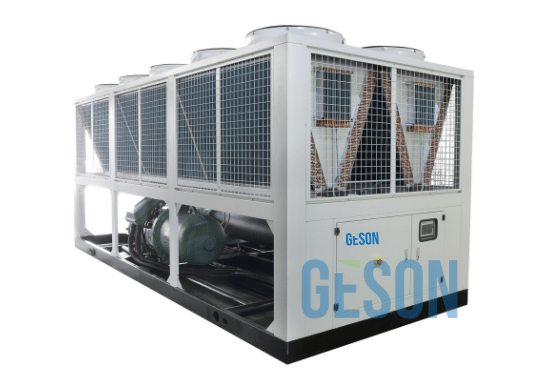
- 50~400ton cooling capacity.
- 12/7℃ for the HVAC system.
- Loading adjusted 100%, 75%, 50%, 25%,0
- Branded screw compressors, simple structure, few breakdowns.
- High efficiency shell and tube evaporator.
- High efficiency copper and aluminum fins condenser.
- Completely tested before the delivery from the factory.
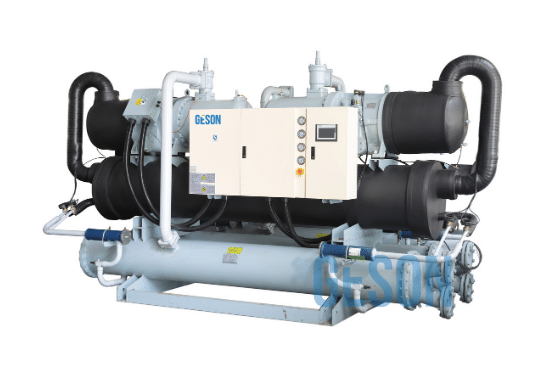
- 100~400 Ton cooling capacity.
- Loading adjusted 100%, 75%, 50%, 25%,0.
- 35% higher efficiency with high COP.
- Available with R22/R134A/R407C/R410A and etc.
- Compact in structure, cover small area, save machine room space.
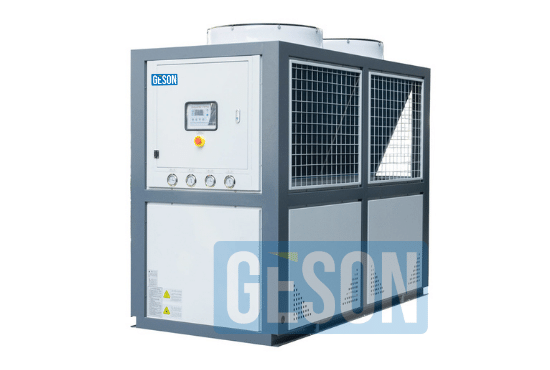
- 3HP~180HP cooling capacity
- No need the water tower
- Easy to maintain and service.
- Completely tested before the delivery.
- Very convinient for the industry users.
- Can work well in any environment.
- The heating function is also available.
GESON Chiller AC System Manufacturing
 |
|
 |
|
 |
|
Air Cooled Screw Chiller Datasheet |
|
| Model | GS-530WD |
| Cooling Capacity (kW) | 530 |
| Total Power (kW) | 152 |
| Refrigerant | R410A |
| Compressor Type | Semi-closed 5:6 asymmetric twin-screw compressor |
| Leaving Water Temp (℃) | 7 |
| Entering Water Temp (℃) | 12 |
| Shipping Weight (kg) | 2850 |
| Operating Weight (kg) | 3150 |
| Length (mm) | 4600 |
| Width (mm) | 2000 |
| Height (mm) | 2500 |
What Is a Chiller AC System?
A chiller AC system produces chilled water or another secondary fluid and circulates it to air-handling units, fan-coil units or process heat exchangers. Unlike a room air conditioner, the refrigerant circuit is normally concentrated at the chiller while water distributes cooling around the building or facility.
Chilled-water systems can serve offices, hotels, hospitals, data centres and industrial processes, but they are not automatically the best choice for every project. Building load, operating hours, redundancy, climate, water availability, plant space, acoustics, controls and local refrigerant rules all affect the decision.
Chiller AC System Selection Inputs
| Selection input | Why it matters |
|---|---|
| Design and part-load cooling demand | Determines capacity, staging, redundancy and annual operating profile |
| Leaving and entering chilled-fluid temperatures | Affects capacity, efficiency, evaporator selection and freeze protection |
| Outdoor design condition or condenser-water condition | Sets the heat-rejection duty and allowable operating envelope |
| Fluid and glycol concentration | Changes heat transfer, pressure drop, pump duty and freeze point |
| Electrical supply | Voltage, frequency, phase, starting limits and harmonic requirements must match the site |
| Noise and location | Influences fan selection, enclosure, vibration isolation and plant layout |
| Water quality and availability | Important for condenser-water treatment, tower operation and makeup-water use |
| Destination regulations | Controls refrigerant, safety classification, pressure equipment, electrical and documentation requirements |
Capacity, compressor, refrigerant, controls, communication interface, certification documents and delivery schedule must be confirmed in the approved model-specific technical submittal.
Air-Cooled vs Water-Cooled Chiller AC
| Factor | Air-cooled arrangement | Water-cooled arrangement |
|---|---|---|
| Heat rejection | Condenser fans reject heat to outdoor air | A condenser-water loop transfers heat to an external heat-rejection system |
| Additional plant | No condenser-water pump or cooling tower; chilled-water accessories are still required | Requires condenser-water pumping and heat rejection; an evaporative tower is common but not the only arrangement |
| Performance driver | Outdoor dry-bulb temperature, airflow and coil condition | Entering condenser-water temperature, flow and heat-rejection performance |
| Water use | No evaporative condenser-water consumption | Open towers require makeup water, blowdown and a water-management program |
| Maintenance | Condenser coils, fans, clearances and refrigerant circuit | Chiller plus pumps, condenser-water treatment and heat-rejection equipment |
| How to compare | Compare certified full-load and part-load data at the same rating conditions and include pumps, fans and tower energy in the complete-plant assessment | |
Chiller AC vs Direct-Expansion Air Conditioning
| Question | Chilled-water system | Direct-expansion system |
|---|---|---|
| How cooling is distributed | Water or another secondary fluid through pumps and piping | Refrigerant runs to indoor coils or packaged units |
| Typical layout | Central or distributed chillers serving AHUs, fan coils or process loads | Room, rooftop, split, multi-split or packaged equipment |
| Control and redundancy | Can support plant sequencing, thermal storage and multiple chiller arrangements | Can provide modular zoning; system architecture varies widely |
| Best choice | Depends on load profile, building layout, climate, code, service capability, lifecycle cost and resilience—not a fixed floor area or tonnage threshold | |
How a Chiller AC System Works
- The evaporator removes heat from the chilled-water or process-fluid loop.
- The compressor raises refrigerant pressure and temperature.
- The condenser rejects the absorbed heat plus compressor input to air or a condenser-water circuit.
- The expansion device reduces refrigerant pressure before it returns to the evaporator.
- Pumps distribute chilled fluid to AHUs, fan coils or process heat exchangers; controls stage equipment to match load and maintain setpoints.
A water-cooled condenser does not make heat disappear: the condenser-water system must reject it through a tower, dry cooler, heat recovery or another approved arrangement. Plant controls and operating sequence must follow the project design and manufacturer instructions.
Applications and Design Priorities
| Application | Important design priorities |
|---|---|
| Hotels and offices | Part-load efficiency, acoustics, zoning, redundancy and maintainability |
| Hospitals and laboratories | Reliability, infection-control interfaces, ventilation loads, redundancy and documented commissioning |
| Data centres | Continuous availability, redundancy, low-ambient operation, controls integration and heat-rejection resilience |
| Manufacturing | Process temperature, load swings, water quality, contamination control and production downtime risk |
| Food and pharmaceutical processes | Validated process temperatures, materials, hygiene boundaries, glycol and regulatory requirements |
Information Needed for Chiller AC Sizing
- Required cooling duty in kW or RT, including how it was calculated
- Peak and minimum load, daily schedule and redundancy requirement
- Leaving and entering fluid temperatures and allowable tolerance
- Fluid type, glycol concentration and required freeze protection
- Outdoor design dry-bulb or condenser-water temperatures, flow and design wet-bulb
- Site elevation, electrical supply, starting-current limits and controls protocol
- Noise limit, installation location, service clearances and corrosion environment
- Destination country and required codes, certifications and documentation
Send the project conditions for model selection and quotation →
Frequently Asked Questions
What is the difference between a chiller and an air conditioner?
A chiller cools a secondary fluid that is circulated to AHUs, fan coils or process equipment. Many direct-expansion air conditioners move refrigerant directly to the indoor cooling coil. Both can cool buildings; the suitable architecture depends on the project.
Is a water-cooled chiller always more efficient?
No universal percentage applies. Compare equipment and complete-plant performance at the same conditions, including chilled-water pumps, condenser-water pumps and tower fans. Climate, load profile and controls can change annual results.
Does every water-cooled chiller need a cooling tower?
It needs an external condenser-water heat-rejection arrangement. An evaporative cooling tower is common, but a dry cooler, approved heat recovery or another engineered method may be used in suitable projects.
Which refrigerant should a chiller AC system use?
The answer depends on the selected compressor and chiller, temperatures, safety code, destination-market regulations, service capability and lifecycle plan. No refrigerant should be treated as a universal replacement.
What information is required for a quotation?
Provide cooling duty, fluid temperatures and concentration, design ambient or condenser-water conditions, electrical supply, application, operating schedule, redundancy, noise limits and destination requirements.
Official Technical References
Send Your Inquiry Today