
4 Ton Industrial Chiller Selection
A 4 ton chiller represents a nominal cooling rate of 48,000 Btu/h, or 14.07 kW. That conversion is a unit value, not a guarantee that a packaged chiller will deliver 14.07 kW in every process. Leaving-fluid temperature, entering-fluid temperature, flow, ambient or condenser-water conditions, fluid type, glycol concentration and fouling allowance all affect the selected duty.
GESON selects each 4 ton industrial chiller against the buyer’s operating point. Send the process load and site conditions before comparing compressor power, pump size or price. The result may be an air-cooled portable package, a water-cooled package, or a different nominal size if the required conditions reduce available capacity.
Request 4 Ton Chiller Selection
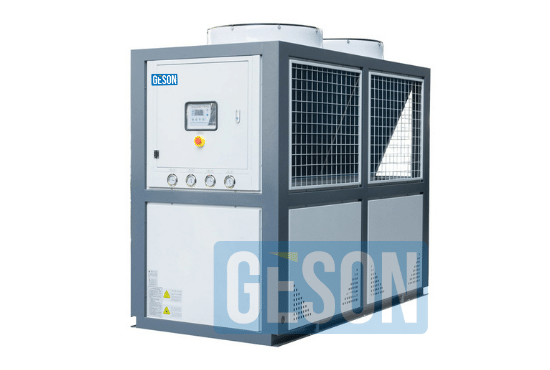
What Does a 4 Ton Chiller Mean?
The refrigeration-ton conversion published by the U.S. National Institute of Standards and Technology (NIST) is 12,000 BtuIT/h per ton, equal to 3.516853 kW. Multiplying that value by four gives the nominal reference below.
| Reference unit | Nominal 4 TR value | Selection meaning |
|---|---|---|
| Refrigeration tons | 4 TR | Nominal capacity class |
| Cooling rate | 48,000 Btu/h | Unit conversion, not a site guarantee |
| Cooling rate | 14.07 kW | Unit conversion, not compressor input power |
Cooling capacity and electrical input are different quantities. A 14.07 kW cooling duty does not mean that the compressor draws 14.07 kW. Input power and COP can only be compared at the same rating conditions and with the same included auxiliaries.
Nominal 4 TR Is Not Guaranteed Process Capacity
AHRI 550/590 and 551/591 treat capacity, efficiency and water-side pressure drop as condition-dependent performance. A quotation should therefore state the conditions used to select the chiller. If a supplier gives only “4 ton” without the fluid temperatures and heat-rejection condition, the capacity comparison is incomplete.
| Selection input | Why it changes the result | What to submit |
|---|---|---|
| Cooling load | Defines the net heat that must be removed | Steady load, peak load and duty cycle |
| Entering and leaving fluid temperature | Sets the evaporator temperature lift and process delta T | Both temperatures in deg C or deg F |
| Process flow | Connects heat load to temperature difference | Required flow and allowable variation |
| Ambient or condenser-water condition | Changes condensing pressure and available capacity | Design ambient, or condenser-water entering/leaving temperatures |
| Fluid and concentration | Changes heat transfer, viscosity, pump duty and freeze protection | Water or glycol type and concentration by weight or volume |
| Site elevation and installation | Can affect air-cooled heat rejection and pump calculations | Elevation, indoor/outdoor location and ventilation limits |
If your load is not yet known, use the process heat balance, measured utility data or a validated heat-load calculation. The guide to correctly sizing a chiller explains the inputs required before a model is chosen.
Portable, Packaged and Central Configurations
“4 ton portable chiller” is often used for a compact package installed beside one machine. Portable describes installation and mobility; it does not define what is included. Confirm the evaporator, pump, reservoir, controls, electrical enclosure and heat-rejection equipment line by line.
| Configuration | Typical project fit | Items to confirm |
|---|---|---|
| Portable packaged chiller | One process machine or a local cooling loop | Casters, pump, tank, bypass, connections and indoor ventilation |
| Skid-mounted package | Permanent installation with defined plant piping | Skid limits, pump head, controls interface and service clearance |
| Central system | Several process users with varying demand | Load diversity, redundancy, distribution pumps and buffer volume |
A small packaged unit can be the right answer when it isolates a critical process. It can be the wrong answer when several users share a stable load or when the plant already has suitable condenser water. GESON reviews the application rather than assuming “portable” is required.
Air-Cooled vs Water-Cooled 4 Ton Chiller
An air-cooled chiller rejects heat directly to outdoor or room air. It avoids a cooling tower and condenser-water pump, but needs adequate airflow and must be selected for the design ambient temperature. Hot-air recirculation, restricted clearances and dusty fins reduce heat-rejection performance.
A water-cooled chiller rejects heat to a condenser-water circuit. It can suit sites with an existing tower or process-water system, but the quotation must define condenser-water entering temperature, leaving temperature, flow, pressure drop and water quality. Tower, pump and treatment energy belong in the system comparison.
| Decision point | Air-cooled | Water-cooled |
|---|---|---|
| Heat-rejection input | Design ambient dry-bulb temperature | Condenser-water entering/leaving temperatures |
| External equipment | Clear airflow path and ventilation | Tower or other heat sink, pump and water treatment |
| Maintenance focus | Coil cleanliness and airflow | Scaling, fouling and condenser-water quality |
Flow, Delta T and Pump Duty
Flow cannot be selected from “4 ton” alone. The required flow depends on heat load, fluid properties and the temperature difference between entering and leaving fluid. A smaller delta T normally requires more flow for the same duty; glycol changes density, specific heat and viscosity.
Pump selection requires a system curve, not just a flow target. Eaton’s pump-selection guidance describes the operating point as the intersection of the pump curve and the system pressure-drop curve. Submit the pressure drop through the process equipment, piping, valves, filters and heat exchanger. GESON can then check whether an integrated or external pump arrangement is appropriate.
Reservoir and Process-Loop Design
A reservoir can add thermal mass, help separate short cycling and provide volume for process changes. It does not automatically solve unstable flow or poor controls. Tank volume should follow the process load profile, acceptable temperature swing, minimum compressor run time and total loop volume.
- Confirm whether the process loop is open or closed.
- State the minimum and maximum flow through each user.
- Identify contamination, corrosion and material-compatibility risks.
- Define bypass, filtration, expansion volume and low-level protection.
For compact loads that need a local package, also compare the small water chiller configuration before fixing the layout.
Fluid, Glycol and Low-Temperature Duty
Water gives favorable heat-transfer and pumping performance when freeze protection is unnecessary. Ethylene glycol or propylene glycol may be required below the safe water range, outdoors, or where the loop can be exposed to freezing conditions. The glycol type and concentration must be stated because they change capacity and pump duty.
Do not select concentration from leaving temperature alone. Check the minimum fluid temperature during operation, shutdown exposure, local safety requirements and the supplier’s fluid data. The explanation of how a glycol chiller works covers the effect of concentration on heat transfer and circulation.
Compressor, Refrigerant, Controls and Power
Compressor type and staging should follow the required operating envelope, part-load profile, control tolerance and service strategy. The old page’s named compressor and fixed model references are not used here because component availability and the approved selection must be confirmed in the written quotation.
- Refrigerant: GESON can supply new chillers using R454B or R513A when the selected model, application and destination requirements are approved in writing.
- Legacy R22 support: GESON can provide parts or refrigerant-related service for legacy GESON R22 equipment, subject to equipment identification and applicable regulations.
- Controls: specify leaving-temperature tolerance, remote start/stop, alarms and required plant interface.
- Power: submit voltage, phase and frequency; do not assume a standard supply is suitable for every destination.
- Efficiency: compare COP or input power only at matching fluid and heat-rejection conditions and with the same auxiliary boundary.
Applications and When 4 Ton Is the Wrong Size
A nominal 4 ton process chiller can serve plastics machinery, laser equipment, machine tools, laboratory loops, food-process equipment or other industrial loads when the calculated duty falls inside the approved performance envelope. The application name alone is not a sizing method.
Choose another size when the peak load exceeds the selected capacity at design conditions, when future expansion is defined, or when low leaving temperature and high ambient reduce available duty. Avoid excessive oversizing as well: short cycling and poor control can follow when the minimum load is far below the chiller’s controllable range.
4 Ton Chiller Price and Lead-Time Inputs
A defensible 4 ton chiller price needs a defined scope. Air- or water-cooled heat rejection, pump duty, reservoir, fluid materials, controls, electrical supply, refrigerant, certification scope, destination and Incoterm can all change the quotation. A bare price without those boundaries is not comparable.
For standard configurations, GESON has a fixed lead time of 30 working days after technical conditions, drawings, payment terms and other written conditions are agreed. Custom scope can change the schedule and must be confirmed in the quotation.
GESON Supply and Documentation Boundaries
- Applicable GESON units have CE and ISO documentation; confirm the selected model and certificate scope in writing.
- Applicable units have 40,000-hour trouble-free operating capability within approved application, installation, operation and maintenance conditions; confirm model-specific scope in writing.
- Final capacity, power, COP, compressor, materials, refrigerant charge, dimensions and shipping scope belong in the approved technical offer.
- Installation clearances, ventilation, water quality, electrical protection and maintenance access must be checked before release.
Request a 4 Ton Chiller Selection
Send the nine items below to contact a GESON engineer. If an item is unknown, mark it “to be calculated” instead of estimating it.
- Application and process description
- Required cooling load and whether it is steady or peak
- Entering and leaving fluid temperatures
- Required flow and known process pressure drop
- Maximum design ambient or condenser-water conditions
- Fluid type and glycol type/concentration
- Voltage, phase and frequency
- Indoor/outdoor installation, elevation and space limits
- Destination country, delivery scope and required documentation
4 Ton Chiller FAQ
How many kW is a 4 ton chiller?
Four refrigeration tons equal 48,000 Btu/h or 14.07 kW of nominal cooling rate using the NIST conversion. This is not the chiller’s electrical input and not guaranteed capacity at every operating point. Confirm leaving and entering fluid temperature, flow, ambient or condenser-water conditions, and fluid concentration before selecting equipment.
Is a 4 ton chiller the same as a 4 ton air conditioner?
No. Both use the same refrigeration-ton unit, but a process chiller cools a circulating liquid loop while an air conditioner normally cools and dehumidifies air. Controls, pumps, reservoirs, evaporator design, operating temperatures and duty cycles can differ, so an HVAC tonnage label does not define an industrial chiller package.
Does a portable 4 ton chiller include a pump and tank?
Not automatically. “Portable” describes the installation concept, not a universal equipment boundary. Ask the supplier to list the pump flow and head, reservoir volume and material, bypass, filtration, connections and controls. The pump must match the process system curve at the required fluid properties and flow.
Should I choose an air-cooled or water-cooled 4 ton chiller?
Choose from site utilities and design heat-rejection conditions. Air-cooled equipment needs clear airflow and the maximum ambient temperature. Water-cooled equipment needs condenser-water temperatures, flow, pressure drop, water treatment and external heat-rejection equipment. Compare total system scope and energy, not the chiller cabinet alone.
What flow rate does a 4 ton water chiller need?
There is no single correct flow without a design delta T and fluid definition. Required flow follows the cooling load, entering-to-leaving temperature difference, fluid density and specific heat. Glycol type and concentration also affect pump head. Submit both temperatures and the process pressure drop for pump and evaporator selection.
What information is needed for a 4 ton chiller price?
Provide the application, cooling load, entering and leaving temperatures, flow, maximum ambient or condenser-water conditions, fluid and glycol concentration, power supply, destination country and required delivery scope. Also state whether a pump, tank, controls interface or special documentation is required. GESON will return the selected conditions with the quotation.
Technical References
- NIST Guide to the SI, Appendix B.8 – refrigeration-ton conversion.
- AHRI 550/590 and 551/591 – water-chilling package rating framework.
- Eaton: Selecting Recirculating Chillers – load, temperature, flow, fluid and ambient inputs.
- Eaton: Liquid Cooling System Pump Overview – pump and system curve operating point.