
Ice Rink Chillers and Refrigeration Systems
An ice rink chiller must be selected for two different duties: building the ice within the required pull-down time and maintaining the finished surface under the highest operating load. GESON engineers indirect ice rink refrigeration systems around the rink area, ice-build schedule, indoor or outdoor conditions, secondary coolant, supply and return temperatures, flow, heat rejection and electrical supply.
We support permanent arenas, seasonal installations, curling sheets and recreational rinks. The proposed equipment can include an air-cooled or water-cooled chiller, secondary-fluid pump, buffer tank, controls and defined connection points. Rink-floor piping, headers, civil work, dehumidification and heat recovery must be identified separately in the project scope.
How an Indirect Ice Rink Cooling System Works
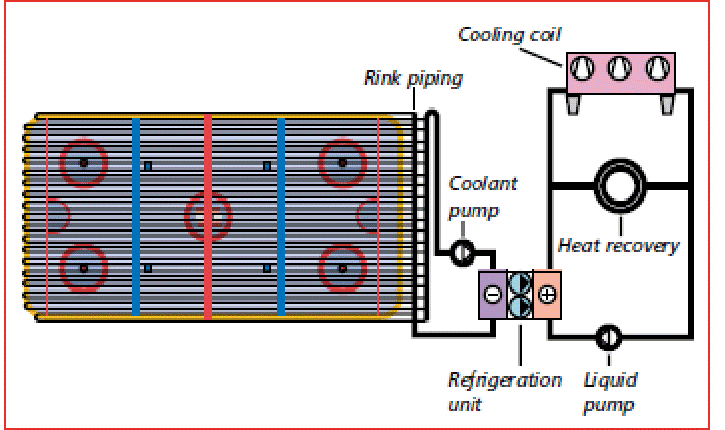
The chiller cools a secondary fluid—commonly a glycol solution or brine—which a pump circulates through headers and a pipe network below the skating surface. Heat moves from the ice and slab into the fluid, then through the chiller evaporator to the primary refrigerant. The condenser finally rejects that heat to outdoor air or a condenser-water circuit.
This indirect arrangement keeps the primary refrigerant within the refrigeration package or machinery area rather than distributing it through the rink floor. The floor circuit still needs hydraulic design: pipe spacing, circuit length, header layout, flow balance and pressure drop all affect surface uniformity.
- Rink loop: slab or mat piping, headers, secondary coolant and circulation pumps.
- Refrigeration package: evaporator, compressor circuit, condenser, expansion device and controls.
- Heat rejection: air-cooled condenser or water-cooled condenser with an external rejection system.
- Facility systems: dehumidification, ventilation, subfloor frost protection and optional heat recovery.
Ice Rink Chiller Sizing Starts with the Heat Load
Rink area alone is not a defensible sizing method. ASHRAE identifies the larger of the ice-building load and the maximum maintenance load as the basis for refrigeration selection. The calculation should separate each load instead of hiding them inside a single watts-per-square-metre shortcut.
| Load input | Design question |
|---|---|
| Initial slab and structure pull-down | What are the starting temperatures and how many hours are available before opening? |
| Flood water cooling and freezing | How much water is applied, at what temperature, to what final ice thickness and temperature? |
| Radiation and lighting | What are the roof, lighting and surrounding-surface temperatures above the ice? |
| Air infiltration and humidity | How much outdoor air enters, and what indoor dew point must the HVAC system maintain? |
| Skaters and resurfacing | What is the occupancy schedule, resurfacing frequency and resurfacing-water temperature? |
| Ground and slab heat gain | What insulation and subfloor frost-protection design is provided? |
| Outdoor weather | For an outdoor rink, what are the design dry-bulb, wind, sun and rain conditions? |
The ASHRAE Handbook ice-rink chapter describes these load components and the time-to-freeze method. The IIHF Ice Rink Guide also treats pull-down time, ice temperature and condenser conditions as design inputs. Any example capacity in those references is context, not a substitute for a project calculation.
Secondary Coolant Temperature, Flow and Concentration
The rink does not normally receive chilled water at standard HVAC conditions. The secondary fluid must remain pumpable and freeze-protected at the lowest expected operating and shutdown temperature. Fluid selection affects the entire system:
- Freezing margin: choose concentration from the fluid supplier’s property data and the project’s minimum temperature.
- Heat transfer: increasing glycol concentration generally changes specific heat and thermal conductivity.
- Pump duty: viscosity and density influence pressure drop, flow and motor power, especially at low temperature.
- Materials: confirm compatibility with seals, pumps, piping, inhibitors and maintenance practices.
- Water quality: prepare the solution with suitable water and monitor concentration, inhibitor condition and contamination.
Provide the fluid type and concentration with the entering and leaving chiller temperatures. A capacity or COP value without those conditions cannot be compared fairly.
Air-Cooled vs Water-Cooled Ice Rink Chillers
| Selection factor | Air-cooled system | Water-cooled system |
|---|---|---|
| Heat rejection | Rejects heat directly to outdoor air. | Rejects heat to a condenser-water loop and external equipment. |
| Site infrastructure | No cooling tower or condenser-water treatment loop. | Requires defined condenser-water temperatures, flow, water treatment and pump/tower scope. |
| Climate input | Selection depends on maximum outdoor dry-bulb and airflow clearance. | Selection depends on condenser-water conditions, often tied to design wet-bulb and tower approach. |
| Maintenance | Condenser coils and fan systems need access and cleaning. | Heat exchangers, pumps, tower and water quality need planned maintenance. |
| Plant comparison | Include chiller fans and any rink-loop pumps. | Include chiller, condenser and rink-loop pumps plus tower fans and water use. |
Use the same rink load, secondary-fluid conditions and weather design point when comparing alternatives. For a seasonal outdoor rink, low-ambient control and freeze protection also need written confirmation.
Permanent, Seasonal and Multi-Rink Projects
A permanent arena often values redundancy, service access, low-load staging and heat-recovery interfaces. A seasonal rink adds transport, setup time, flexible hoses or headers, weather exposure and drainage. A multi-sheet facility needs plant sequencing that matches the active sheets and their different resurfacing schedules.
Discuss these decisions before selecting equipment:
- Required ice-build time and scheduled opening date.
- Normal skating load versus tournaments, shows or special events.
- Whether one circuit or compressor must maintain ice during service.
- Indoor machinery-room or outdoor equipment location.
- Sound limits, access clearances and lifting route.
- Control interface with rink pumps, dehumidification and building management.
- Potential heat-recovery uses such as service-water preheating or space heating, evaluated project by project.
Refrigerant, Safety and Legacy R22 Support
Refrigerant selection is not a marketing checkbox. It must match the compressor and system design, secondary-fluid temperature, ambient or condenser conditions, destination rules, machinery-room arrangement and availability of qualified technicians. GESON can evaluate new R513A or R454B equipment where the selected design and operating envelope permit; the offered refrigerant and safety provisions will be stated in the written proposal.
Ammonia is used in some ice-rink plants, but GESON does not make a blanket ammonia-system supply claim on this page. The U.S. EPA notes that ammonia is toxic and requires site-specific hazard review, preventive maintenance, detection and independent ventilation. Any ammonia plant must be engineered and operated under applicable local codes by qualified parties.
GESON can assess model-dependent spare-parts and refrigerant-related service for legacy GESON R22 equipment. Send the nameplate, serial number, photos, fault history and site location. Support depends on parts availability, destination regulations and qualified service scope; repair, retrofit and replacement should be compared before work begins.
What to Send for Ice Rink Chiller Selection
| Required project data | Example of the needed detail |
|---|---|
| Rink use and dimensions | Hockey, curling or recreational; length, width and number of sheets. |
| Indoor or outdoor conditions | Design dry-bulb, wet-bulb, humidity, wind and solar exposure as applicable. |
| Ice-build target | Starting slab/water conditions, final ice thickness and hours available. |
| Operating schedule | Season length, daily hours, occupancy and resurfacing schedule. |
| Secondary loop | Fluid type, concentration, supply/return temperatures, flow and pressure drop. |
| Equipment scope | Chiller only, pump/tank package, redundancy, controls, floor piping and heat rejection boundaries. |
| Site utilities | Voltage, phase, frequency, water availability and installation location. |
| Destination | Country, applicable project standards and required documentation. |
Contact our engineer with these inputs. The proposal can then state the rated cooling duty, fluid conditions, heat-rejection conditions, electrical data and supply boundaries instead of presenting an unqualified nominal tonnage.
Ice Rink Chiller FAQ
How do you size an ice rink chiller?
Calculate both the load required to build the ice within the specified time and the maximum load required to maintain it. Include rink dimensions, slab and flood-water pull-down, radiation, lighting, infiltration, humidity, skaters, resurfacing, ground heat and outdoor weather. Select against the larger duty at stated secondary-fluid and heat-rejection conditions.
What fluid circulates under an ice rink?
Indirect systems circulate a secondary coolant such as an inhibited glycol solution or brine through the floor network. The correct fluid and concentration depend on minimum temperature, pumpability, material compatibility and local practice. Provide supplier property data because concentration changes heat transfer and pressure drop.
How cold should an ice rink chiller operate?
There is no universal leaving-fluid temperature for every rink. Ice type, target surface condition, slab construction, pipe layout, fluid concentration, flow and building conditions determine the required supply and return temperatures. The chiller must be rated at that agreed operating point.
Can one chiller serve more than one ice rink?
Yes, a central plant can serve multiple sheets when the load calculation, hydraulic circuits, control valves, pump arrangement and staging are designed together. The system should account for simultaneous ice building, resurfacing peaks, low-load operation and the required level of redundancy.
How much does an ice rink chiller cost?
Price depends on rated load and conditions, air- or water-cooled heat rejection, compressor circuits, secondary-fluid package, controls, redundancy, refrigerant, voltage and delivery scope. A rink area alone cannot produce a reliable quotation; send the project data listed above for a technical and commercial proposal.
Can GESON support an existing R22 ice rink chiller?
GESON can assess legacy GESON equipment for model-dependent spare-parts and refrigerant-related service. Availability and the legal service route vary by destination. Provide the unit identification and fault information so repair, retrofit and replacement options can be reviewed.
Request an Ice Rink Refrigeration Proposal
Send the rink dimensions, use, location, ice-build time, design weather, secondary fluid and concentration, supply/return temperatures, flow, equipment scope, power supply and destination country. Our engineers will review the design point before recommending a chiller configuration.