
10 Ton Industrial Chiller Selection
A 10 ton chiller has a nominal cooling rate of 120,000 Btu/h, or approximately 35.17 kW of refrigeration. That number is cooling capacity鈥攏ot compressor input power鈥攁nd it is meaningful only when the leaving-fluid temperature, entering-fluid temperature, flow, fluid composition and condenser condition are stated.
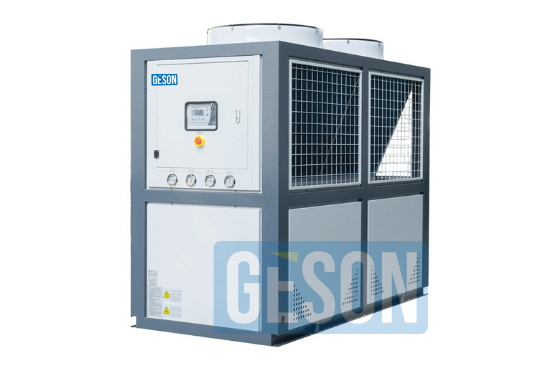
GESON can select air-cooled or water-cooled industrial chillers near the 10 TR duty point for process equipment, production lines and building services. The quoted model is based on the actual load and operating conditions rather than the words 鈥�10 ton鈥� alone.
What Does 10 Tons of Cooling Mean?
ASHRAE defines one ton of refrigeration as 12,000 Btu/h, approximately 3,517 W. Therefore:
- 10 TR = 120,000 Btu/h
- 10 TR 鈮� 35.17 kW of cooling
- 10 TR is not 10 kW of electrical input
The nominal tonnage does not guarantee 35.17 kW at every condition. Available capacity changes with chilled-fluid temperature, ambient or condenser-water condition, flow, fouling allowance, glycol concentration and compressor operating envelope.
Specify the Rating Conditions Before Comparing Models
AHRI defines published capacity and efficiency at stated rating conditions. A 10 ton air-cooled chiller selected at one outdoor temperature cannot be compared directly with a water-cooled model selected at different chilled-water or condenser-water conditions.
| Selection item | Information required | Why it changes the selection |
|---|---|---|
| Process load | Sustained and peak heat load in kW or Btu/h; batch pull-down time if applicable. | Defines the net cooling duty and any transient allowance. |
| Chilled-fluid temperatures | Entering and leaving temperatures, or supply setpoint and expected return temperature. | Sets evaporating condition and available capacity. |
| Flow | Required operating flow and permitted range. | Determines heat transfer, fluid temperature rise and pump operating point. |
| Fluid | Water or glycol type, concentration and minimum operating temperature. | Changes heat capacity, viscosity, pressure loss, freeze protection and materials review. |
| Condenser condition | Maximum outdoor dry-bulb for air-cooled units, or entering/leaving condenser-water temperatures and flow. | Changes condensing pressure, capacity and input power. |
| Site | Indoor/outdoor location, altitude, dust, humidity, corrosion risk and airflow clearance. | Affects condenser selection, enclosure and operating limits. |
| Electrical supply | Voltage, phase and frequency at the installation country. | Defines motors, controls and protective-device requirements. |
| Control interface | Remote enable, run/fault contacts, communication protocol and interlocks. | Defines integration and commissioning scope. |
10 Ton Air-Cooled vs Water-Cooled Chillers
| Project factor | Air-cooled 10 ton chiller | Water-cooled 10 ton chiller |
|---|---|---|
| Heat rejection | Rejects heat directly to ambient air through the condenser coil and fans. | Transfers heat to a condenser-water loop and external heat-rejection system. |
| Site infrastructure | No cooling tower or condenser-water pump is normally required. | Requires condenser-water flow, heat rejection, water treatment and associated piping. |
| Main rating input | Maximum design outdoor dry-bulb and airflow conditions. | Entering/leaving condenser-water temperatures, flow and water-side pressure drop. |
| Maintenance focus | Condenser cleanliness, fan condition and unobstructed airflow. | Water quality, scaling, fouling, condenser pressure drop and tower-system maintenance. |
| Typical decision driver | Simpler installation where water use or tower infrastructure is undesirable. | Projects with suitable condenser-water infrastructure and plant-level efficiency objectives. |
Neither condenser type is automatically 鈥渂etter.鈥� Compare the complete installed system at the same cooling load, fluid temperatures and site conditions, including pumps and heat-rejection equipment.
10 TR Is Not the Same as a 10 kW Chiller
Search specifications often mix refrigeration tons, cooling kilowatts and electrical kilowatts. They describe different quantities:
| Term | Meaning | Approximate relationship |
|---|---|---|
| 10 TR chiller | Nominal refrigeration capacity. | Approximately 35.17 kW cooling at the stated rating conditions. |
| 10 kW cooling chiller | Cooling capacity of 10 kW. | Approximately 2.84 TR. |
| 10 kW electrical input | Power consumed by the declared equipment boundary. | Does not state cooling capacity without COP or kW/ton at defined conditions. |
When requesting a quotation, label every number as cooling capacity, equipment input power or pump power. This prevents a 10 kW cooling request from being interpreted as a 10 TR request.
How to Check Whether 10 Tons Is Enough
For a steady liquid loop, calculate heat removal from mass flow, fluid specific heat and the entering-to-leaving temperature difference. Use temperature- and concentration-specific fluid properties for glycol rather than the clean-water shortcut.
A project load can also include heat from motors, hydraulic systems, product pull-down, radiation, warm makeup fluid and the circulation pump. Add only loads that occur simultaneously, then evaluate load variation and start-up duty. The industrial chiller sizing guide provides SI and U.S. equations and a worked calculation.
- Do not size from machine nameplate electrical power unless the heat-to-fluid fraction is known.
- Do not apply a fixed oversizing percentage to every process.
- Do not use nominal tonnage without checking the manufacturer selection at the required condition.
- Consider multiple circuits, staging or a buffer tank where the load changes rapidly.
Pump Flow, Head and Hydraulic Scope
Thermo Fisher鈥檚 chiller-selection guidance treats flow and application pressure loss as separate inputs. The pump must deliver the required flow at the combined pressure drop of the process equipment, chiller heat exchanger, piping, hoses, valves, strainers and fittings.
A 10 ton packaged chiller quotation should state:
- Pump curve or duty point, not maximum flow alone.
- Maximum allowable process pressure and required bypass or relief arrangement.
- Reservoir or buffer-tank volume, if included.
- Wetted materials, connection sizes and filtration requirements.
- Minimum flow protection and equipment interlock logic.
- Whether pump heat is included in the net available cooling capacity.
Industrial Applications Near the 10 Ton Duty Point
Nominal 10 TR systems may be considered for plastic-processing equipment, machine tools, laser systems, printing, food and beverage processes, chemical processing, test equipment and small HVAC zones. The application label does not determine the chiller size; the load profile and fluid interface do.
For injection molding, provide mold and hydraulic-oil loads separately when they use different temperatures. For fermentation or food-process loops, identify the product pull-down schedule and required heat-exchanger separation. For laser and machine-tool cooling, provide the equipment maker鈥檚 limits for temperature, flow, pressure, fluid chemistry and interlock behavior.
What Changes a 10 Ton Chiller Price?
A technically valid price requires a defined duty and scope. Air-cooled and water-cooled units with the same nominal tonnage can have different compressors, heat exchangers, pumps, tanks, controls and installation requirements.
- Rated cooling capacity and fluid temperatures.
- Maximum ambient or condenser-water design condition.
- Water or glycol type and concentration.
- Pump flow, head, tank and hydraulic accessories.
- Voltage, phase, frequency and control interface.
- Refrigerant, safety provisions and destination-market requirements.
- Materials, enclosure, redundancy and optional heat recovery.
- Shipping scope, documentation and commissioning support.
GESON does not publish one universal 10 ton chiller price because a price without these conditions may describe the wrong machine. Request a model-specific technical selection and commercial quotation.
Refrigerant and Legacy-Service Options
GESON can evaluate new 10 ton chiller configurations using R454B or R513A where the selected compressor, unit design, temperature range, destination regulations and qualified service capability permit. The exact refrigerant and safety provisions will be confirmed in the written proposal.
For legacy GESON R22 equipment, spare-parts and refrigerant-related service can be reviewed by model and destination. Support depends on the nameplate, fault condition, parts availability, local refrigerant rules and qualified service scope.
Installation and Commissioning Checklist
- Verify the foundation, service access, ventilation and condenser clearance.
- Confirm voltage, phase, frequency, grounding and protective devices.
- Flush the external loop and inspect strainers before connection.
- Fill with the approved fluid and concentration; remove trapped air.
- Confirm flow, pressure and rotation before applying the process load.
- Insulate cold piping where condensation can occur.
- Test alarms, flow protection, remote enable and process interlocks.
- Record baseline temperatures, flow, pressure, ambient, current and alarm status.
For site planning and start-up details, use the industrial chiller installation guide together with the model-specific manual and approved drawings.
10 Ton Chiller FAQ
How many kW is a 10 ton chiller?
Ten refrigeration tons equal approximately 35.17 kW of cooling, or 120,000 Btu/h. This is a unit conversion, not a guarantee of capacity at every condition. The selected chiller must show net cooling at the required fluid temperature, flow, fluid composition and condenser condition.
Is a 10 ton chiller the same as a 10 kW chiller?
No. A 10 TR chiller represents approximately 35.17 kW of nominal cooling, while a 10 kW cooling chiller is approximately 2.84 TR. Electrical input in kW is a third quantity and must be identified separately from cooling capacity.
Should I choose an air-cooled or water-cooled 10 ton chiller?
Choose from site infrastructure and design conditions. Air-cooled units avoid a condenser-water loop but require suitable ambient and airflow. Water-cooled units require external heat rejection, water treatment and condenser-water data. Compare complete-system performance at the same duty.
Can a 10 ton chiller use glycol?
Yes, when the unit and pump are selected for the specified glycol type, concentration and temperature. Glycol changes heat capacity, viscosity, pressure loss and freeze protection, so the quotation must use the correct fluid properties rather than clean-water data.
How much does a 10 ton industrial chiller cost?
Price depends on rated conditions, condenser type, refrigerant, pump duty, tank and hydraulic scope, controls, electrical supply, materials and destination requirements. Send the full selection inputs for a technical proposal and itemized quotation.
What information is required for 10 ton chiller selection?
Provide the application, sustained and peak load, entering/leaving fluid temperatures, flow, pressure loss, fluid and glycol concentration, maximum ambient or condenser-water condition, electrical supply, control needs and destination country.
Request a 10 Ton Chiller Quote
Send the application, required cooling load, entering and leaving fluid temperatures, flow, total pressure loss, fluid or glycol concentration, maximum ambient, voltage/phase/frequency and destination country. Include the cooled-equipment manual and layout when available.